"Chote bacchon ka chashma kaise utaarein?" is one of the most common things parents ask us. Most of the time it means: can my child stop needing glasses? Sometimes it simply means how to take a small child's glasses off without bending them. This article answers both, honestly.
Can a child's glasses be removed for good?
It depends on why the child wears them.
- Minus power (short sight, myopia). The child sees near things clearly but far things blurred. This is the most common reason school children wear glasses. The eye has grown a little too long, and it does not shrink back. No eye exercise, diet, drop or home remedy makes this power go away.
- Plus power, a squint or a lazy eye. These are treated differently, and some children need glasses less as they grow. Only an eye doctor can tell you if this applies to your child.
So for most short-sighted children, the realistic goal is not to remove the glasses but to stop the power from rising quickly. A child whose power stays low has an easier time later, with thinner lenses and more options as an adult.
Why taking the glasses off does not help
Many parents worry that glasses make the eyes "lazy" or the power go up. They do not. Leaving glasses off does not train the eyes. The child simply sees a blurred board, strains, and can fall behind in class. For some eye conditions, not wearing the right glasses can hold a young child's vision development back. Use the glasses as your eye doctor advises, and never change the power or stop the glasses on your own.
What can slow a child's power from rising
1. Myopia control spectacle lenses
Ordinary single vision lenses correct the blur straight ahead. Myopia control lenses do that too, but they also change how light falls on the side of the eye, which is linked to the eye growing longer. They look like normal glasses, and the child wears them all day.
2. Time outdoors
Eye doctors commonly advise children to spend more time playing outside in daylight. It is one of the simplest habits that is linked with less short sight.
3. Breaks from near work
Long stretches of mobile, tablet, homework or reading close up keep the eyes focusing near. Short breaks to look at something far away, and holding books and screens at a comfortable distance, are good habits.
4. Regular eye tests
Children's power can change quickly. A test every six to twelve months, or as your eye doctor says, shows whether the power is rising and whether the plan is working. See how often eyes should be tested.
ZEISS MyoCare lenses: how they work
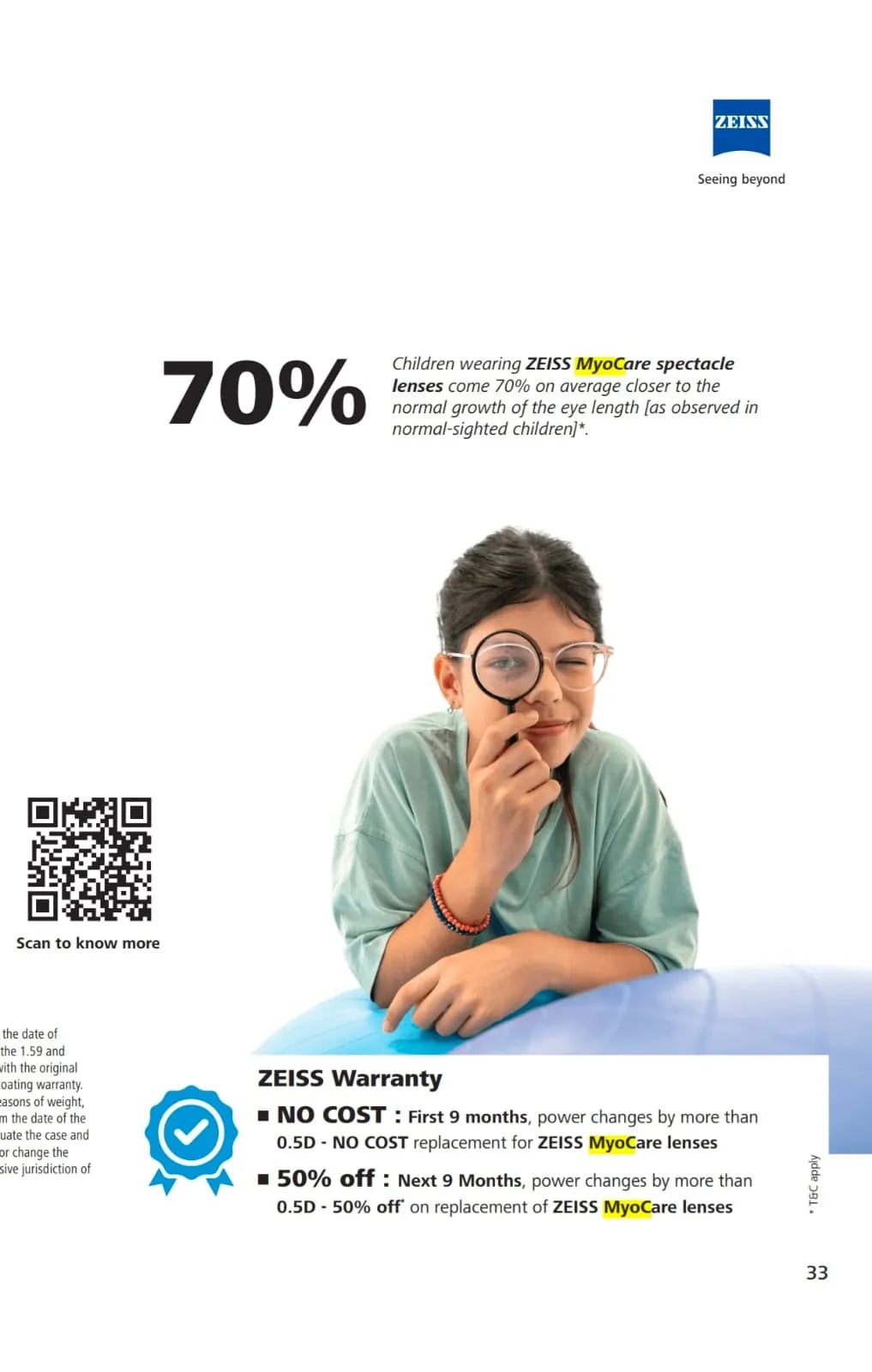
ZEISS MyoCare is a spectacle lens made for short-sighted children. According to ZEISS:
- Clear centre, treatment rings around it. The middle of the lens gives sharp vision straight ahead. Around it, rings alternate between normal correction and a defocus zone, half and half. ZEISS calls this C.A.R.E. technology.
- Two versions. MyoCare has a 7 mm clear centre. MyoCare S has a larger 9 mm centre with a softer effect, for children who find the first one harder to get used to.
- Up to 3.5 times fewer fast increases. In ZEISS's comparison, fewer children wearing MyoCare had their power rise by more than 0.75 D in 12 months than children in ordinary single vision lenses.
- Easy to get used to. In a two-year trial in China, ZEISS reports that 95% of children adapted within three days.
- The brochure also states that children in MyoCare lenses came, on average, 70% closer to the eye growth seen in children without short sight.
These lenses slow the increase. They do not reverse short sight or remove the glasses, and results vary from child to child.
ZEISS MyoCare at Deepak Optical, Aligarh
We stock ZEISS MyoCare. The lenses cost ₹7,000 for the pair, and the frame is chosen and priced separately. Bring your child's latest prescription, or have the eyes tested at the shop, and we will fit the lenses in a frame that sits well on a small face. For frame fit and size, read what size glasses suit a child and our children's eyewear guide.
How to take a small child's glasses off properly
If you meant taking the glasses off without damaging them, teach your child this early:
- Use both hands. Hold both arms (temples) near the hinges and slide the glasses straight forward. Pulling from one side bends the frame and loosens the fit.
- Never put them face down. Lenses on a table get scratched. Fold them and set them down resting on the arms.
- Keep a case nearby. At bedtime, bath time and sport, the glasses go into the case, not on the bed or in a school bag.
- Clean with water and a microfibre cloth, not a shirt. See how to clean glasses without scratching.
- For toddlers, a soft strap or a flexible frame helps the glasses stay on and survive being pulled off. If the frame keeps slipping or pinching, bring it in for an adjustment.
Bacchon ka chashma kaise hataye? (Hinglish)
Agar aapke bacche ko minus power hai (door ka dhundla dikhta hai), to koi exercise, khana, dawai ya gharelu nuskha chashma hamesha ke liye nahi hata sakta. Chashma band karne se aankh mazboot nahi hoti, baccha bas dhundla dekhta hai. Jo kiya ja sakta hai, woh hai power ko badhne se rokna:
- Myopia control lens, jaise ZEISS MyoCare. Hamare yahan yeh ₹7,000 mein milte hain (dono lens, frame alag).
- Roz bahar dhoop mein khelna.
- Mobile, tablet aur padhai ke beech chhote break, aur door dekhna.
- Har 6 se 12 mahine mein eye test, ya jaise doctor kahein.
LASIK jaisi surgery bacchon ke liye nahi hai. Woh badon mein, power stable hone ke baad hi socha jaata hai.
This article is general information, not medical advice. For persistent symptoms or any sudden change in your vision, see an eye-care professional.
Worried your child's power keeps going up?
Send us your child's latest prescription on WhatsApp, or come in for an eye test. We will explain whether myopia control lenses like ZEISS MyoCare suit your child, and what they cost, before you decide.
Ask Deepak Optical about lenses for your child.
Call nowAsk about kids lensesGet directions